Dawson City Travel Guide: Everything You Need to Know
Dawson City is unlike any other place in Canada — a Gold Rush boomtown preserved in amber at the confluence of the Yukon and Klondike rivers. This complete guide covers what to see, where to stay, where to eat, and how to make the most of your time here.
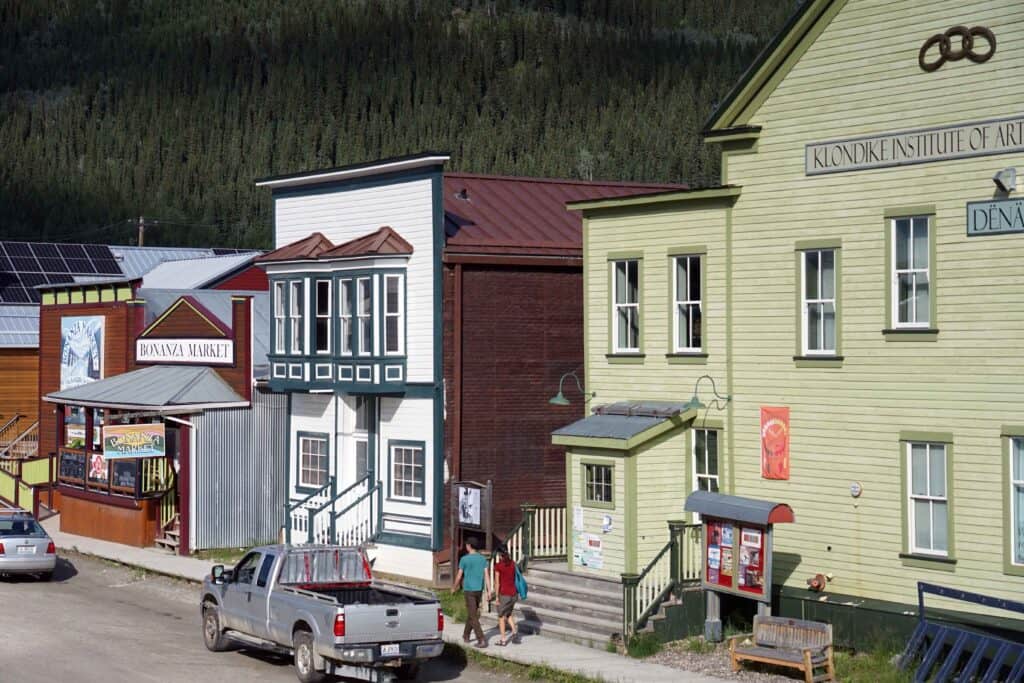
Dawson City sits at the confluence of the Yukon and Klondike rivers, and arriving here still feels like you’re crossing a threshold. This was once the largest city west of Winnipeg and north of San Francisco — a place of 40,000 people with electricity, telephones, an opera house, and running water, all conjured from wilderness in less than two years. Today the population hovers around 1,400, but the bones of the boomtown remain. The false-fronted hotels, the gravel streets, the boardwalks, the river at the end of every block — it’s a place that has mostly resisted the urge to polish itself, and it’s better for it.
## Getting There
Most visitors arrive by road. From Whitehorse, the Klondike Highway (Highway 2) runs 535 kilometres north — plan on six to seven hours without lingering. The road is paved the whole way, but this is the Yukon, not a prairie freeway: expect frost heaves, wildlife on the shoulders (and sometimes standing right on the centre line), and the odd construction zone.
Fuel is available in Carmacks (355 km north of Whitehorse) and Stewart Crossing (444 km north). Don’t roll past either on a quarter tank and a wave, especially heading north. The stretch between Stewart Crossing and Dawson City (91 km) is classic central Yukon — low hills, big sky, no services.
Coming from Alaska, the Top of the World Highway (Highway 9) climbs out of the Yukon River valley on the west side of Dawson and heads for the U.S. border at Poker Creek, 108 kilometres away. The crossing is summer-only, typically late May through mid-September; hours shift over the season, so check before you commit. On both the Canadian side and the American continuation to Chicken, Alaska, you’re driving a gravel ridgeline with mountains rolling away on both sides. On a clear day it feels like you’re following the spine of the continent.
Air North (Yukon’s Airline) runs scheduled flights between Whitehorse and Dawson City, with seasonal service on to Old Crow. The Dawson City Airport sits about 19 kilometres east of town on the Klondike Highway.
For Yukoners, Air North is more than just a booking code. Founded in 1977 and still locally owned — with a 49 percent stake held by the Vuntut Gwitchin First Nation of Old Crow — it was named Best Airline in Canada in the 2020 Tripadvisor Travellers’ Choice Awards, the first Indigenous-owned northern carrier to take that title. People notice the generous baggage allowance and the fact that you still get real food on short northern hops. Whitehorse is the hub, so most visitors flying to Dawson will connect there.
On the river itself, the George Black Ferry shuttles vehicles and pedestrians across the Yukon at Dawson, 24 hours a day through the main season until roughly mid-September, free of charge. Once freeze-up arrives, crews wait for good ice and build an ice bridge — usually sometime between late December and March, though the exact timing changes with the year.
## What to See and Do
### Front Street and the Boardwalk
Start on Front Street, the boardwalk-lined main drag along the Yukon River. The buildings here are mostly the real thing, not theme-park facades. The Palace Grand Theatre, originally built in 1899 by showman Arizona Charlie Meadows and later reconstructed by Parks Canada, is one of the finest surviving examples of gold rush frontier architecture on the continent. Parks Canada runs guided tours in summer — check current schedules at the Dawson City Visitor Information Centre. Even if you never watch a performance, the building itself is worth stepping inside.
### History & Parks Canada Sites
The [Dawson City Museum](https://dawsonmuseum.ca/) on Fifth Avenue fills the old Territorial Administration Building (1901), and it’s essential if you want to understand what 1898 actually looked and felt like. Give yourself a solid two hours. The film collection alone will reset your sense of the place. It’s typically open from late May through early September; admission is around $10 for adults.
Down on the riverfront, the [SS Keno](https://parks.canada.ca/lhn-nhs/yt/klondike/culture/ss-keno) — a preserved sternwheeler that once carried ore from the Keno Hill silver mines — sits permanently beached. You can wander around it for free, and Parks Canada staff offer guided interpretation in season.
Farther up Bonanza Creek, [Dredge No. 4](https://parks.canada.ca/lhn-nhs/yt/klondike/culture/drague-dredge), 13 kilometres south of town, is the machine that reshaped the valley — the largest wooden-hulled bucketline dredge in North America, seven storeys tall, still sitting in the pond it dug for itself. Summer tours are excellent and run roughly $10 per adult. Drive south on Bonanza Creek Road and follow the signs. While you’re there, stop at Discovery Claim, where a cairn marks the exact spot of the August 1896 gold strike that set off the Klondike stampede.
On Eighth Avenue, Robert Service’s Cabin is where the “Poet of the Klondike” lived while writing his most famous pieces. Parks Canada staff do daily in-character readings. It sounds hokey; it isn’t. A short walk away, Jack London’s Cabin — reconstructed on its original site — anchors a small London museum. Both sites are free to visit and worth the detour.
### Dänojà Zho Cultural Centre
The [Dänojà Zho Cultural Centre](https://danojazho.ca/), operated by the Tr’ondëk Hwëch’in First Nation, anchors the other half of Dawson’s story: the history and living culture of the people who were here long before 1898 and are still very much here today. Exhibits are thoughtfully put together and the staff know their history. Don’t treat this as an optional extra — it changes how you see the rest of town. You’ll find it directly across the street from the ferry terminal.
Just downriver, the Tr’ochëk Historic Site at the mouth of the Klondike River marks the Tr’ondëk Hwëch’in’s most important traditional fish camp. In season, you’ll find interpretive programming that brings that fishing and camp life into the present.
### The Midnight Dome
The Midnight Dome is the hill that rises directly behind Dawson, a lookout the town has used for more than a century. The summit is an 8-kilometre drive up King Street and then Dome Road — gravel, but fine for any car driven with a bit of respect. From the top you get the classic Dawson view: the Yukon and Klondike meeting below, the floodplain laid out like a map, mountains in every direction.
On the summer solstice (June 21), locals and visitors alike drive or hike up to watch the sun skim the horizon without really setting. If you’d rather earn the view, the hike up from town via the Moosehide Trail takes about three hours return; the trailhead starts near the ferry landing.
### Diamond Tooth Gertie’s
Diamond Tooth Gertie’s Gambling Hall on Fourth Avenue is Canada’s oldest legal casino, running since 1971. The slots and tables are there, but the real draw is the nightly floor show — cancan dancers, period costumes, and live music layered over the town’s own history. Shows usually run three times a night (often around 8:30 p.m., 10:30 p.m., and 12:30 a.m.). Admission is roughly $10; it’s the atmosphere you’re paying for, not a high-roller fantasy.
### The Klondike Goldfields
South of Dawson, the Bonanza Creek valley is still being mined. Driving the Bonanza Creek Road (unpaved, roughly 16 km to Dredge No. 4 and Discovery Claim) gives you a clear sense of how thoroughly dredges chewed up the landscape. The creek has been rerouted, the valley floor turned over again and again, and long windrows of tailings stretch off for kilometres.
### Canoe Trips & River Tours
The Yukon River at Dawson is one of the north’s classic canoe routes, and the river still defines the town more than any road. [Klondike Adventure Tours](https://www.klondikeadventuretours.com/), based in Dawson, focuses on the river — from short rafting trips just outside town to multi-day wilderness expeditions down the Yukon. They also handle canoe and gear rentals, camping outfitting, and shuttles to and from various put-ins and take-outs.
If you want to see the river through a Hän lens, [Fishwheel Charters](https://fishwheeltoursyukon.com/) offers a two-hour boat tour that runs down past Moosehide Village and historic Fort Reliance. Owned and operated by Tommy Taylor — currently the only Yukon First Nation tour guide working out of Dawson — the trip weaves Hän stories, salmon fishing, and traditional fishwheels into the river you see from the boat. Tickets are sold at the Little Birch Cabin on Front Street.
## Day Trips
### Dempster Highway
The Dempster Highway starts 40 kilometres east of Dawson City on the Klondike Highway. Even if you’re not planning the full 736-kilometre push to Inuvik, the first 72 kilometres to the Tombstone Range and the Tombstone Territorial Park Visitor Centre make a superb day run.
The visitor centre at Kilometre 72 has strong exhibits on the park’s ecology and geology, and staff who know the trails and weather patterns. From pullouts along the highway you can see the jagged granite peaks of the Tombstone Range rising out of rolling tundra. From Dawson, this is an easy half-day or full-day trip, depending on how often you stop and wander.
### Top of the World Highway
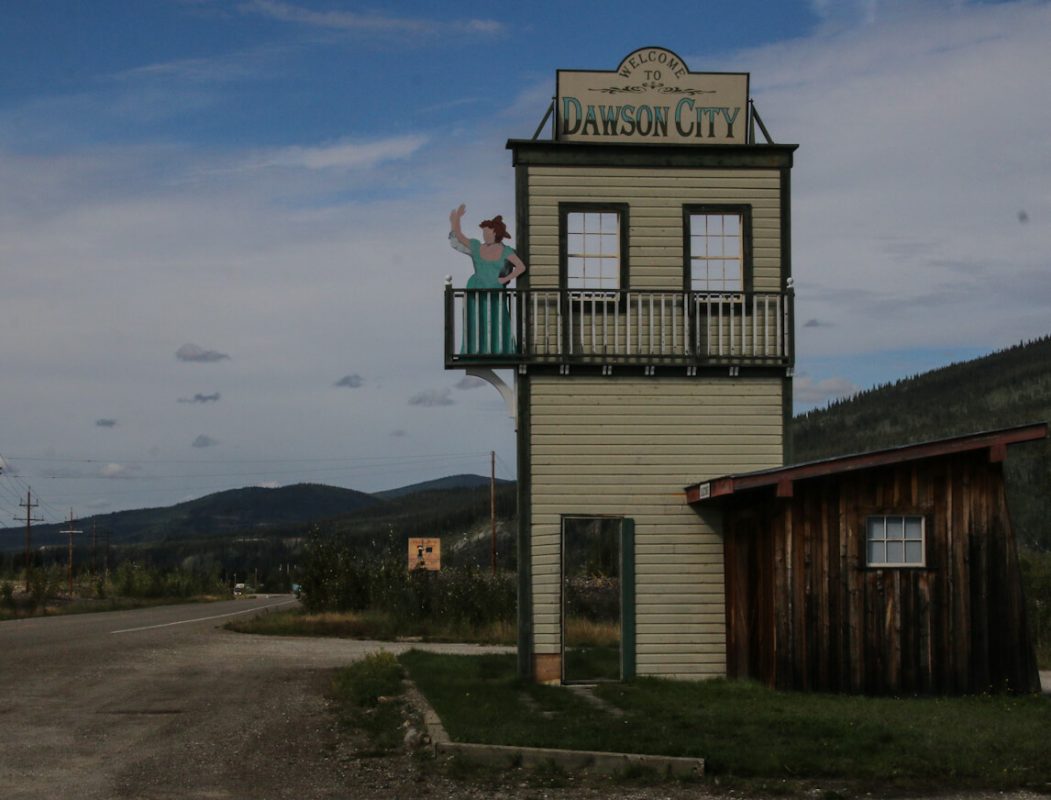
The Top of the World Highway begins at the ferry landing on the west side of the Yukon River. Even if you only have an hour, a short drive up and back gives you the ridgeline experience. The gravel road climbs steeply from the river and stays high; within the first 20 kilometres you’re surrounded by open country with long views into both the Yukon and Alaska.
### Chicken, Alaska
If you’ve got a full day and don’t mind gravel, the Top of the World Highway to Chicken, Alaska is a memorable loop. It’s 108 kilometres from Dawson to the border at Poker Creek, then about 10 kilometres farther on the Taylor Highway to Chicken. The town itself is tiny — a handful of residents, a café, a gift shop, and a sense that you’ve come to the edge of the map. Check border hours carefully before you go; if the crossing is closed, you’re turning around at the top.
## Where to Stay
[Bombay Peggy’s Inn](https://www.bombaypeggys.com/) is Dawson’s most atmospheric bed for the night — a restored Victorian brothel turned boutique inn, with period-style rooms and a bar locals actually use. If you’re aiming for July, book months ahead. Rates usually run in the $150–220 per night range.
The [Dawson City Bunkhouse](https://dawsoncitybunkhouse.com/) is the best value in town: clean private rooms, shared dorms, and a relaxed hostel-style setup. Common areas make it easy to meet other travellers, and the staff know what’s happening around town. Expect roughly $45 for a dorm bed and up to around $120 for a private room.
The [Westmark Inn](https://hollandamericahotels.com/destinations/dawson-city-hotel/) is Dawson’s biggest property, with more than 100 rooms. It’s reliable and comfortable, and while it doesn’t have the character of a century-old boarding house, it suits tour groups and anyone who wants hotel-style consistency.
The [Downtown Hotel](https://www.coasthotels.com/the-downtown-a-coast-hotel) on Second Avenue is central and comfortable, and its Sourdough Saloon is home base for the Sourtoe Cocktail.
For camping, the Yukon government campground at the west end of Church Street is a well-maintained option for both tents and RVs. South of town on Bonanza Creek Road, Guggieville RV Park is popular with larger rigs. In July, and especially on Dawson City Music Festival weekend, both formal campgrounds and informal spots fill up — book ahead or arrive early.
## Where to Eat
The [Drunken Goat Taverna](https://thedrunkengoat.ca/) turns out Greek food that would hold its own in a much bigger city — generous lamb dishes, fresh pita, and a menu that keeps both locals and visitors coming back. It’s open for lunch and dinner; in peak season, don’t be surprised by a wait.
The Eldorado Hotel’s Restaurant and Sluice Box Lounge is one of Dawson’s long-running dining rooms, with a full-service restaurant on one side and a more casual lounge on the other.
For breakfast and snacks, Cheechako’s Bakery is the place for fresh bread, pastries, and a morning coffee. Gold Village Chinese Restaurant is a steady, year-round option. Bonton and Co. is a friendly spot for coffee and lighter fare. The Aurora Inn and the Westmark Dawson City both operate dining rooms that are straightforward, dependable choices through the summer.
At the [Downtown Hotel’s](https://www.coasthotels.com/the-downtown-a-coast-hotel) Sourdough Saloon you’ll find the Sourtoe Cocktail — a shot containing a real, preserved human toe. The tradition has been running since 1973. The one rule: the toe must touch your lips. Swallowing the toe earns you a $2,500 fine and a lot of unimpressed locals. The saloon serves standard bar food alongside the ritual.
## Events
The Dawson City Music Festival, held the third weekend of July, pulls in performers and audiences from across Canada and beyond, and turns the town into one big venue for a few days. If you’re planning to come specifically for the festival, think in terms of booking accommodation a year ahead.
In February, the Yukon Quest International Sled Dog Race traditionally passes through Dawson City as part of its 1,600-kilometre route between Whitehorse and Fairbanks, Alaska. Routes and formats have shifted in recent years, but when Dawson is on the course, watching teams arrive and leave in deep cold is a different kind of spectacle — quiet, determined, and unforgettable.
## Best Time to Visit
June through August brings 20+ hours of daylight, warm days that often push past 25°C, and every attraction running on its summer schedule. The summer solstice (June 21) is marked on the Midnight Dome, with people staying up to watch the midnight sun make a slow arc above the horizon. July is peak season, and the music festival on the third weekend adds another layer of busy.
September trades long days for colour. The hills and river valleys around Dawson turn gold and red, the air cools, and the roads and boardwalks get quieter. Tourist operations start winding down after Labour Day, but if you’re here for landscape and hiking, this is when the country is at its most vivid.
February is the time for the Yukon Quest (in the years when Dawson is on the route) and for aurora. Dawson sits well north of most packaged “aurora tour” bases, and on clear winter nights the northern lights can pour over the valley.
## Practical Tips
Cell coverage is solid in Dawson itself. Once you head up the Dempster Highway, across the ferry onto the Top of the World Highway, or into any backroad, expect it to disappear quickly. Download offline maps before you leave town.
The George Black Ferry normally runs 24 hours a day until about mid-September, free of charge. After that, shoulder-season river conditions get unpredictable; check current information from the Yukon government before planning any westward travel on the Top of the World.
Carry some cash. A surprising number of Dawson businesses still don’t take cards, and the ATM at the bank is the town’s only consistently reliable machine.
Bears are part of life in and around Dawson. The town runs a Bear Smart program: don’t leave food or garbage in vehicles or outside tents, and stay alert in and around the campgrounds and trailheads.
If you’re on a longer journey — paddling the Yukon River from Whitehorse or cycling the Dempster — the Dawson post office will accept resupply parcels. Many paddlers and cyclists ship food and gear ahead and pick it up in town.
---
## See Also on TheKlondike.net
- [The Tr’ondëk Hwëch’in: The Original People of the Klondike](/blog/trondk-hwechin-original-people-klondike) — whose land Dawson City was built on
- [The Klondike Gold Rush: How It Started](/blog/klondike-gold-rush-how-it-started) — the discovery that created the city
- [Dawson City at Its Peak](/blog/dawson-city-at-its-peak) — what the boomtown looked like in 1898
- [Dredge No. 4: The Machine That Ate the Klondike](/blog/dredge-number-4-klondike) — the gold dredge on Bonanza Creek
- [Yukon’s Historic Sites: A Complete Visitor’s Guide](/blog/yukon-historic-sites-visitor-guide) — all the major heritage sites
- [Gold Rush Photography: Tips for Photographing Dawson City](/blog/photography-tips-dawson-city) — making the most of the northern light
- [Eating Well in Dawson City](/blog/eating-well-dawson-city-restaurants) — where to eat and the Sourtoe Cocktail
- [What It’s Like to Drive the Dempster Highway](/blog/driving-dempster-highway) — the gravel road that starts just east of town